


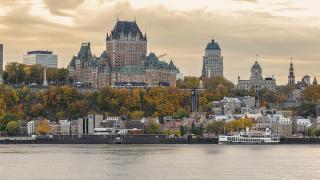



Halifax is a harbour city on Canada's Atlantic edge, known to most visitors for its waterfront boardwalk, its star-shaped fort on the hill and the cruise ships that tie up below it. Yet this is where the oldest surviving lighthouse in North America still stands, where a newspaper editor's six-hour speech won a free press, where the first responsible government in the British Empire took office, where the crews of a cable ship brought home the Titanic's dead, where a railway dispatcher stayed at his key while a ship burned, and where nearly a million newcomers first stepped onto Canadian soil.
This is Halifax's bright side, in roughly the order it happened. Some of its best-loved stories have grown in the telling, and we say so where they have. Every chapter ends with something you can go and see.
1758: Sambro Island Light
Nine years after Halifax was founded, the colony lit a lighthouse on Sambro Island at the mouth of the harbour, one of the most dangerous approaches on the coast. The stone tower was finished in 1759 and raised to 25 metres in 1906. It is the oldest surviving lighthouse in North America.
In the 2000s, with the light's future in doubt, mariners and heritage groups campaigned, the provincial legislature passed a resolution in 2007, and in 2007–08 the light and foghorn were put on solar power; the tower was restored in 2016.
 Sambro Island Light, lit in 1758, the oldest surviving lighthouse in North America. Image: Dennis G. Jarvis, CC BY-SA 2.0, via Wikimedia Commons.
Where to see it today: the island has no regular public access, but the red-and-white tower is visible from Crystal Crescent Beach and Sandy Cove, about 30 minutes' drive south of the city.
1796 and 1866: A Tower and a Park for a Shilling
In 1796 the British built the Prince of Wales Tower on the point at the harbour mouth, the oldest Martello-style tower in North America. Seventy years later the land around it, no longer needed for defence, was leased to the city in 1866 for 999 years at one shilling a year, and became Point Pleasant Park. When Hurricane Juan knocked down about three-quarters of its trees in 2003, the city replanted it: more than 70,000 trees of the native Acadian forest had gone in by 2008.
 The Prince of Wales Tower of 1796 in Point Pleasant Park. Image: Dennis G. Jarvis, CC BY-SA 2.0, via Wikimedia Commons.
The Halifax Public Gardens began in 1837 as the garden of a horticultural society and opened to everyone in 1867: 16 acres of Victorian beds, ponds and a bandstand of 1887. Juan wrecked them too; a radio telethon raised $1 million and they reopened on Canada Day 2004.
 The 1887 bandstand and flower beds of the Halifax Public Gardens. Image: Dennis G. Jarvis, CC BY-SA 2.0, via Wikimedia Commons.
Where to see it today: Point Pleasant Park is at the south end of the peninsula, open daily; in summer Shakespeare by the Sea plays at its Cambridge Battery. The Public Gardens, on Spring Garden Road, open at 8 a.m. from about late April to November and close 30 minutes before sunset; entry is free, with free tours from June to October.
1803 and 1857: The Town Clock and the Noon Gun
The Town Clock on Citadel Hill began keeping time for the garrison on 20 October 1803 and has kept it for the town ever since. Above it, the present star-shaped Citadel was built between 1828 and 1856. A gun has been fired from its ramparts at noon every day since about 1857, except on Christmas Day.
 The Town Clock, keeping time for Halifax since 1803. Image: Hunter Bloor, CC BY-SA 4.0, via Wikimedia Commons.
Where to see it today: the Halifax Citadel National Historic Site, 5425 Sackville Street, is open daily from 9 a.m. to 5 p.m. from early May to early November (adult $22). Costumed interpreters play the 78th Highlanders and the Royal Artillery as they were in 1869. In winter only the grounds are open, and the noon gun still fires.
 Interpreters fire the noon gun on the Citadel ramparts. Image: elPadawan, CC BY-SA 2.0, via Wikimedia Commons.
1835 and 1848: A Free Press and Responsible Government
On 1 January 1835 Joseph Howe's newspaper, the Novascotian, printed a letter accusing the town's magistrates of corruption, and Howe was charged with seditious libel. He defended himself, speaking to the jury for more than five hours and asking them to "leave an unshackled press as a legacy to your children". They acquitted him in about ten minutes.
 The statue of Joseph Howe outside Province House. Image: Hayden Soloviev, CC BY 4.0, via Wikimedia Commons.
Howe went into politics, and on 2 February 1848 Nova Scotia became the first colony in the British Empire to have responsible government: a cabinet answerable to the elected assembly, not to the governor. The assembly still meets in Province House, opened in 1819, the longest-serving legislative building in Canada. Charles Dickens visited in 1842 and said it was like looking at Westminster through the wrong end of a telescope.
 Province House, the seat of Nova Scotia's legislature since 1819. Image: Louperivois, CC BY-SA 3.0, via Wikimedia Commons.
Where to see it today: Province House, 1726 Hollis Street, is free to visit on weekdays from 8:30 a.m. to 4 p.m., with guided tours in summer. Howe's statue stands in front of it.
1840 and 1887: Steamships and an Art School
Samuel Cunard was born in Halifax in 1787. In 1840 his steamer Britannia began a regular service from Liverpool to Halifax and Boston, the start of the Cunard Line's regular steamship service across the Atlantic.
 The statue of Samuel Cunard on the Halifax waterfront. Image: Peter Spiro, CC BY-SA 4.0, via Wikimedia Commons.
In 1887 Anna Leonowens, later famous through The King and I, helped found the Victoria School of Art and Design in Halifax with three other women. It became NSCAD University, and in 1969 Canada's first independent art school to grant degrees. Leonowens invented much of her own life story (her birthplace, her husband's rank, her travels), but the school is real.
 Anna Leonowens, co-founder of the art school that became NSCAD University. Image: Unknown authorUnknown author, Public domain, via Wikimedia Commons.
Where to see it today: the 10-foot bronze of Cunard, unveiled in 2006, stands near the Cunard Centre on the waterfront. NSCAD's historic campus is on Granville Street, in the 19th-century buildings of the Granville Mall.
1912: Bringing Home the Titanic's Dead
After the Titanic sank on 15 April 1912, the White Star Line chartered Halifax ships to recover the bodies. The cable ship Mackay-Bennett left on 17 April with an embalmer, a clergyman from All Saints Cathedral and a hold full of ice and coffins. Its crew recovered 306 of the 328 bodies eventually found, buried 116 at sea and brought 190 back to Halifax on 30 April.
 The cable ship Mackay-Bennett in dry dock at Halifax. Image: Notman Studio, Public domain, via Wikimedia Commons.
The crew paid for the burial of one small boy they could not name, the "Unknown Child". DNA testing announced in 2007 identified him as Sidney Leslie Goodwin, 19 months old, from England.
Where to see it today: 150 Titanic victims are buried in Halifax, 121 of them in Fairview Lawn Cemetery at the north end of Windsor Street, more than in any other cemetery in the world. One grave reads "J. Dawson": he was Joseph Dawson, a coal trimmer, and the film's character was not named after him. A deck chair from the ship is in the Maritime Museum of the Atlantic.
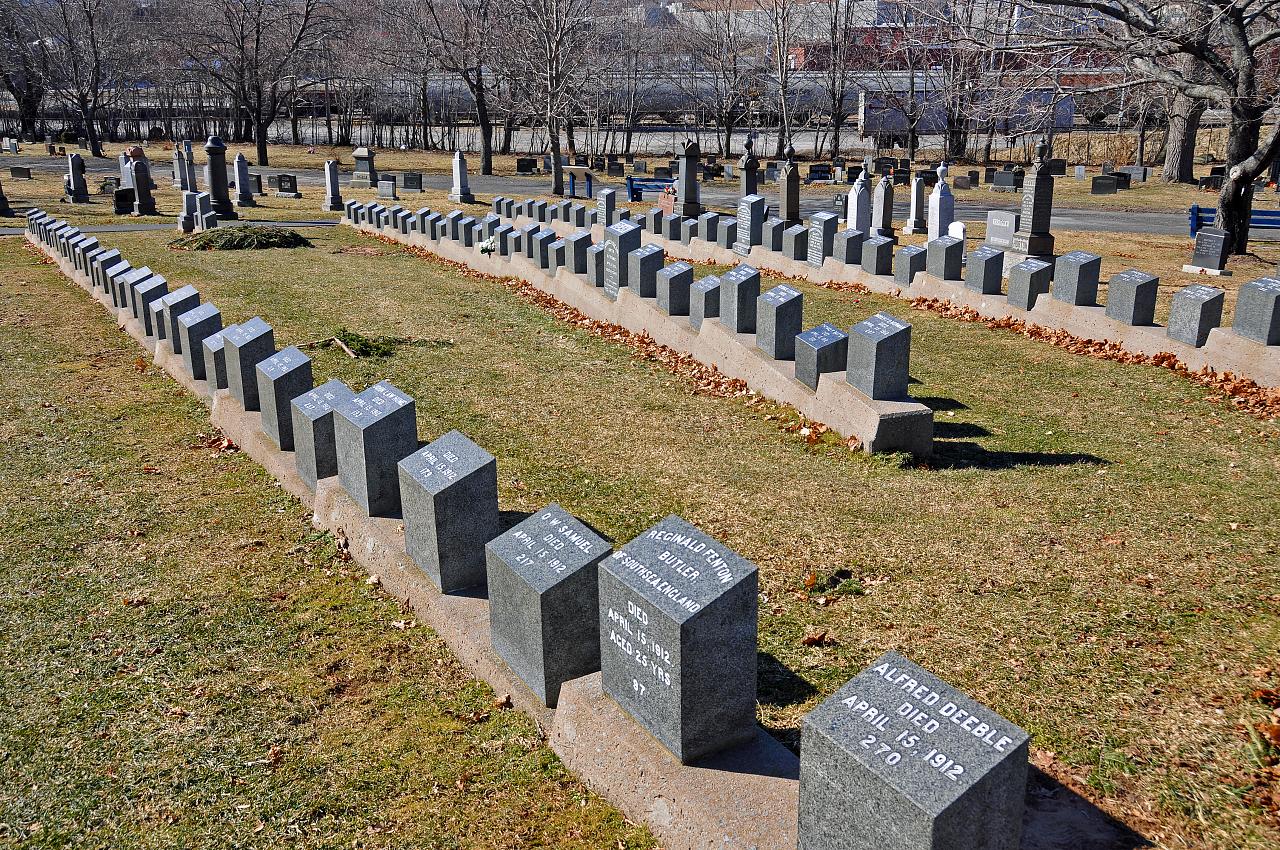 Titanic graves in Fairview Lawn Cemetery. Image: Dennis G. Jarvis, CC BY-SA 2.0, via Wikimedia Commons.
6 December 1917: The Explosion and the Rescuers
At 8:45 on the morning of 6 December 1917, the French munitions ship Mont-Blanc collided with the Norwegian Imo in the Narrows and caught fire. At 9:04 it exploded, levelling the north end of Halifax. The Remembrance Book names 1,782 dead, and about 9,000 people were injured.
As the ship burned, the train dispatcher Vince Coleman stayed at his key at Richmond station to warn the overnight express from Saint John, carrying about 300 passengers. His message is usually quoted as ending, "Guess this will be my last message. Good-bye boys." He was killed; the train was held outside the city. Historians debate how much his message alone stopped it, so he is best described as credited with saving it.
 Vince Coleman's telegraph key, watch and pen in the Maritime Museum of the Atlantic. Image: Paulo O from Halifax, Canada, CC BY 2.0, via Wikimedia Commons.
Help came within hours. A relief train left Boston at 10 p.m. that night with doctors, nurses and supplies, led by Abraham Ratshesky, and pushed through snowstorms to arrive on the morning of 8 December, the first medical team from outside to reach the city. Thousands had been hurt by flying glass: 12 eye doctors treated 592 patients, and Dr George Cox of New Glasgow alone performed 75 operations in four or five days. The mass blinding helped lead to the founding of the Canadian National Institute for the Blind in March 1918.
Where to see it today: the explosion exhibit at the Maritime Museum of the Atlantic, 1675 Lower Water Street, has Coleman's key, watch and pen and the Remembrance Book. The Fort Needham Memorial Bell Tower overlooks the Narrows; its first bells were given by Barbara Orr, who lost her whole family in the explosion. A ceremony is held there every 6 December at 9:04 a.m. One of the harbour ferries is named Vincent Coleman.
 The Halifax Explosion Memorial Bell Tower at Fort Needham. Image: Dennis G. Jarvis, CC BY-SA 2.0, via Wikimedia Commons.
1918 and 1971: A Tree for Boston
In 1918 Nova Scotia sent a Christmas tree to Boston to thank the city for its help. The gift lapsed, and in 1971 a group of Lunenburg County tree growers revived it; the provincial government took it over in 1976. Every year since, a spruce or fir of 12 to 16 metres has been cut in Nova Scotia and lit on Boston Common in late November or early December, in front of a crowd of about 20,000.
 A town crier and Santa Claus welcome Nova Scotia's tree on Boston Common. Image: Briancua, CC BY-SA 4.0, via Wikimedia Commons.
Where to see it today: the tree is lit in Boston, but its story starts here: the cutting in Nova Scotia each November is a public occasion, and the Halifax Explosion exhibits explain why the gift is still sent.
1918 to 1921: The Hydrostone
To rehouse the families of the north end, the Halifax Relief Commission hired the planner Thomas Adams and the architects Ross & Macdonald. They designed the Hydrostone: more than 300 terraced homes built from fire-resistant concrete block, laid out along grassy boulevards, with a row of shops. It is described as Canada's first public housing project, and it is still a sought-after neighbourhood.
 The shops of the Hydrostone Market on Young Street. Image: Edward, CC BY-SA 4.0, via Wikimedia Commons.
Where to see it today: the Hydrostone is in the north end, between Young Street and Duffus Street; the shops and cafés of the Hydrostone Market are on Young Street.
1928 to 1971: Pier 21
From 1928 to 1971 nearly a million immigrants entered Canada through Pier 21. Through it also came about 50,000 war brides and 22,000 children after the Second World War, more than 2,000 British children evacuated from the bombing, and more than 100,000 refugees; and from it left 496,000 Canadian service members going to war. It became Canada's national museum of immigration in 2011.
 Children with Red Cross workers at Pier 21 in 1948. Image: E.A. Bollinger, Public domain, via Wikimedia Commons.
Where to see it today: the Canadian Museum of Immigration at Pier 21, 1055 Marginal Road, opens daily in summer from 9:30 a.m. to 5:30 p.m. and Wednesday to Sunday in winter (adult $19). Its archives can help visitors find a relative's arrival record.
 The Canadian Museum of Immigration at Pier 21. Image: Skeezix1000, CC BY-SA 3.0, via Wikimedia Commons.
1946 to 2018: Viola Desmond
Viola Desmond ran a beauty salon and school in Halifax. On 8 November 1946, in New Glasgow, she sat in the whites-only section of the Roseland Theatre and refused to move. She was jailed overnight and fined $26 on the pretext that she had not paid the one-cent tax difference on the seat. Her challenge failed in court, but the case became a landmark of the fight against segregation in Canada.
 Viola Desmond, who refused to leave a whites-only cinema section in 1946. Image: Unknown authorUnknown author, Public domain, via Wikimedia Commons.
On 14 April 2010 Nova Scotia granted her a free pardon, the first posthumous one in Canada, and in 2018 she became the first Canadian woman to appear alone on a regularly circulating banknote, the $10 bill unveiled in Halifax that March.
Where to see it today: take the harbour ferry Viola Desmond, launched in 2016, to Dartmouth; her star on Canada's Walk of Fame is at the Halifax ferry terminal. Pull out a $10 note.
 The harbour ferry Viola Desmond, launched in 2016. Image: Colin Stepney, CC BY-SA 4.0, via Wikimedia Commons.
11 September 2001: Operation Yellow Ribbon
When American airspace closed on 11 September 2001, about 40 transatlantic flights were sent to Halifax, more than to any other Canadian airport, with somewhere between 7,000 and 8,400 passengers and crew on board. The city opened Exhibition Park, Mount Saint Vincent University, schools and gyms, and many families took strangers into their own homes for several days until the flights could leave.
Where to see it today: there is no permanent memorial; the airport marked the 20th anniversary in 2021.
2010: Africville
Africville, on the shore of Bedford Basin, was a Black community founded in the 1840s. Denied city services, it was cleared between 1964 and 1970 and its residents moved away; the church was bulldozed in 1967. Former residents and their descendants never stopped returning for a summer reunion, and on 24 February 2010 the city apologised. A replica of the Seaview African United Baptist Church opened in 2011 as the Africville Museum, and the site became Africville Park.
 The replica of the Seaview African United Baptist Church, now the Africville Museum. Image: Dennis G. Jarvis, CC BY-SA 2.0, via Wikimedia Commons.
Where to see it today: the Africville Museum opens Tuesday to Saturday from 10 a.m. to 4 p.m. in summer and on weekdays after Labour Day (adult $10). The Africville Reunion is held in the park every July.
How to See Bright Halifax
A self-guided walk, about 5 km. Start at the Town Clock and climb to the Citadel for the noon gun. Walk down to Province House and Howe's statue, then to the waterfront: the Maritime Museum of the Atlantic, the Cunard statue and the ferry terminal with Viola Desmond's star. Follow the boardwalk south to Pier 21, then cut back up to the Public Gardens on Spring Garden Road.
 The Halifax waterfront and a harbour ferry at sunset. Image: Tony Webster from San Francisco, California, CC BY-SA 2.0, via Wikimedia Commons.
Further afield:
- Fairview Lawn Cemetery, the Hydrostone and the Fort Needham bell tower in the north end.
- Point Pleasant Park and the Prince of Wales Tower.
- The Africville Museum on Bedford Basin.
- Sambro Island Light from Crystal Crescent Beach.
Dates to know:
- 2 February: the anniversary of responsible government, 1848.
- Summer: the Africville Reunion in July; Shakespeare by the Sea in Point Pleasant Park.
- November: the tree for Boston is cut and sent south.
- 6 December, 9:04 a.m.: the Halifax Explosion memorial at Fort Needham.