New Brunswick is best known for the Bay of Fundy and its enormous tides, which Parks Canada says reach 12 metres or more, for the flowerpot sea stacks of Hopewell Rocks, and for being Canada's only officially bilingual province, with English and French given equal status in its laws. It is also known for lobster (Shediac calls itself the Lobster Capital of the World), Acadian culture and the noisy Tintamarre parade on 15 August, the world's longest covered bridge at Hartland, the Reversing Falls in Saint John, and the warm beaches of Kouchibouguac National Park. This guide explains each one and how to see it.
Quick facts (checked October 2026)
- Tides: up to 12 m or more along the Bay of Fundy (Parks Canada); about 8.5 m twice a day at Saint John (Discover Saint John).
- Languages: English and French are both official languages of New Brunswick under section 16(2) of the Canadian Charter of Rights and Freedoms. In the 2021 census, 34% of residents could speak both, the second-highest share after Quebec.
- National Acadian Day: 15 August, celebrated with the Tintamarre.
- Longest covered bridge: Hartland, 390.75 m (1,282 ft).
- Two national parks: Fundy and Kouchibouguac.
The Bay of Fundy tides
The Bay of Fundy, between New Brunswick and Nova Scotia, has some of the highest tides in the world. Twice a day the sea floods in and drains out again, and along the shore the difference between low and high water can be the height of a three- or four-storey building. Parks Canada describes Fundy's tides as reaching up to 12 metres or more. At Saint John the tide rises and falls by about 8.5 metres.
The tides shape almost everything there is to do on this coast: you can paddle where you walked a few hours earlier, and at low tide you can walk on the ocean floor. The trick is timing. Look up the tide tables for the place you are visiting before you set off, and plan to see it at both low and high tide.
Hopewell Rocks
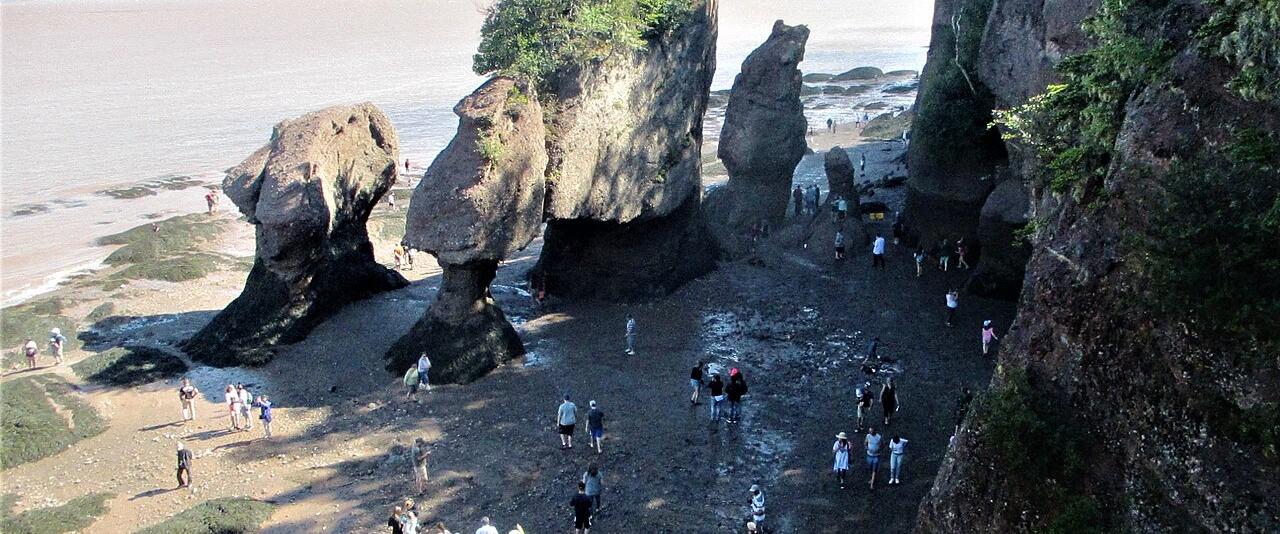
The best-known place to see the tides is Hopewell Rocks Provincial Park at Hopewell Cape, south of Moncton. Along about two kilometres of shoreline stand more than twenty free-standing sea stacks, the "flowerpots": tall columns of rock worn narrow at the base by the sea, with trees still growing on top. Several have names, such as Elephant, Bear, Dinosaur, ET and Mother-in-Law.
At low tide you can walk on the ocean floor and among the rocks; at high tide the water rises up their sides and the floor disappears. The park pass is valid for two consecutive days, so you can come back to see both tides. The park advises checking tide times before you go, wearing sturdy shoes, and taking care on the ledges, which are often slippery and can shift underfoot.
 The flowerpot sea stacks of Hopewell Rocks, with forest growing on their tops. Image: The Cosmonaut, CC BY-SA 2.5 ca, via Wikimedia Commons.
Practical info: 131 Discovery Road, Hopewell Cape, New Brunswick. Tide tables are in Atlantic Time and are posted on the provincial parks website (nbparks.ca).
Fundy National Park
Fundy National Park protects a stretch of the bay's coast and the Acadian forest behind it. Parks Canada lists the things to do as walking on the ocean floor at low tide, paddling at high tide, and hiking forest trails to waterfalls, as well as camping and guided programmes. The park is open all year, with a winter programme; the visitor centre and campgrounds have seasonal hours. The visitor centre is at 8642 Route 114.
Inside the park, the red covered bridge at Point Wolfe is one of the many wooden covered bridges that still stand in New Brunswick.
Saint John and the Reversing Falls
Saint John, the only city on the Bay of Fundy, has one of the oddest sights of the tides: the Reversing Falls Rapids. Where the Saint John River meets the bay through a narrow rocky gorge, the flow changes direction with the tide:
- At low tide, the river pours out into the bay, forming rapids and whirlpools.
- At high tide, the rising bay pushes back up the gorge and reverses the river's flow, creating rapids and standing waves in the other direction.
- At slack tide, between the two, the water goes briefly calm. This is the only time boats can pass between river and bay.
You can watch from Wolastoq Park and Fallsview Park, or from the lookout and rooftop at The Plank at Reversing Falls, which also shows a 13-minute film. To see the rapids change direction, check the tide times and visit around low and high tide on the same day.
 The Reversing Falls rapids in the gorge below the bridge in Saint John. Image: Sajith T S, CC BY-SA 2.0, via Wikimedia Commons.
Canada's only officially bilingual province
New Brunswick is the only province where both of Canada's official languages are official at provincial level. Section 16(2) of the Charter of Rights and Freedoms states that English and French are the official languages of New Brunswick and have equal status in its legislature and government, and section 16.1 gives the English and French linguistic communities equal rights, including their own schools and cultural institutions.
In practice this means provincial government services are available in both languages. In the 2021 census, about 30% of residents had French as their first official language, and 34% could speak both English and French. Broadly, French is strongest in the north and east, along the Acadian Peninsula and the Northumberland Strait, and English in the south and west.
Acadian culture, Caraquet and the Tintamarre
The Acadians are descendants of French settlers who arrived in the region in the 1600s, and New Brunswick is the heart of Acadian life today. Their national holiday, National Acadian Day on 15 August, was chosen at the Acadian convention in Memramcook in 1881, and the Acadian flag, the French tricolour with a gold star, dates from 1884.
On 15 August Acadian towns hold the Tintamarre: people dress in the colours of the flag and parade through the streets making as much noise as they can with pots, horns, whistles and anything else to hand. The best known is in Caraquet, on the Acadian Peninsula, where it closes the two-week Festival acadien de Caraquet. The 2026 festival ran from 2 to 15 August; 2027 dates had not been announced when this guide was written.
 Acadian flags in the crowd at the Grand Tintamarre in Caraquet on 15 August 2026. Image: Hayden Soloviev, CC BY 4.0, via Wikimedia Commons.
The Société Nationale de l'Acadie also stages a national celebration in a different town each year: Dieppe hosted it in 2026, and Campbellton is due to host in 2027.
Lobster and Shediac
New Brunswick's coasts are lobster country, and Shediac, on the Northumberland Strait east of Moncton, calls itself the Lobster Capital of the World. Visitors stop for photographs with the giant lobster sculpture at the town's entrance and then go to Parlee Beach, a long sandy beach a short drive away. Lobster is caught in different seasons in different fishing areas, so ask what is local and fresh when you order; in coastal towns you will find lobster rolls, boiled lobster suppers and lobster on boat tours.
 The giant lobster sculpture in Shediac. Image: Jiaqian AirplaneFan, CC BY 3.0, via Wikimedia Commons.
The Hartland Covered Bridge
New Brunswick is known for its wooden covered bridges, and the most famous is at Hartland, on the Saint John River in the west of the province. At 390.75 metres (1,282 feet), Parks Canada recognises it as the longest covered bridge in the world. It opened in 1901 without a roof; after spring ice took out two spans in 1920, it was repaired and covered in 1922. It was designated a National Historic Site of Canada in 1977. You can drive across it, or use the pedestrian walkway attached to its side.
 The Hartland Covered Bridge over the Saint John River. Image: Dennis G. Jarvis, CC BY-SA 2.0, via Wikimedia Commons.
Kouchibouguac National Park
On the east coast, Kouchibouguac National Park is the other side of New Brunswick's nature: warm beaches, estuaries and salt marsh on the Northumberland Strait instead of Fundy's cliffs and tides. Parks Canada highlights its beaches, its forests and wetlands, its cycling and paddling, and its status as a Dark Sky Preserve. The park sits on unceded Mi'gmaq territory. It is open all year, but visitor services run only from January to October, so check the park's bulletins before you go.
 Visitors on the beach at Kouchibouguac National Park on the Northumberland Strait. Image: jockrutherford from Owen Sound, ON, CC BY-SA 2.0, via Wikimedia Commons.
How to see it all
- Fundy coast: base yourself in Moncton, Alma (by Fundy National Park) or Saint John. Hopewell Rocks, Fundy National Park and Saint John can be combined in two or three days if you plan around the tides.
- Acadian coast: Shediac, Bouctouche and Kouchibouguac lie along the Northumberland Strait north of Moncton; Caraquet is further north on the Acadian Peninsula.
- The Saint John River valley: Hartland is upriver from Fredericton, the provincial capital, on the way towards the Maine border.
- When to go: summer and early autumn are best for beaches, festivals and park services. The tides happen all year.