
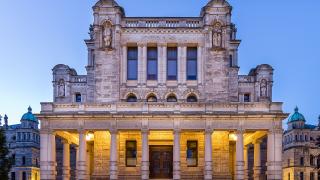

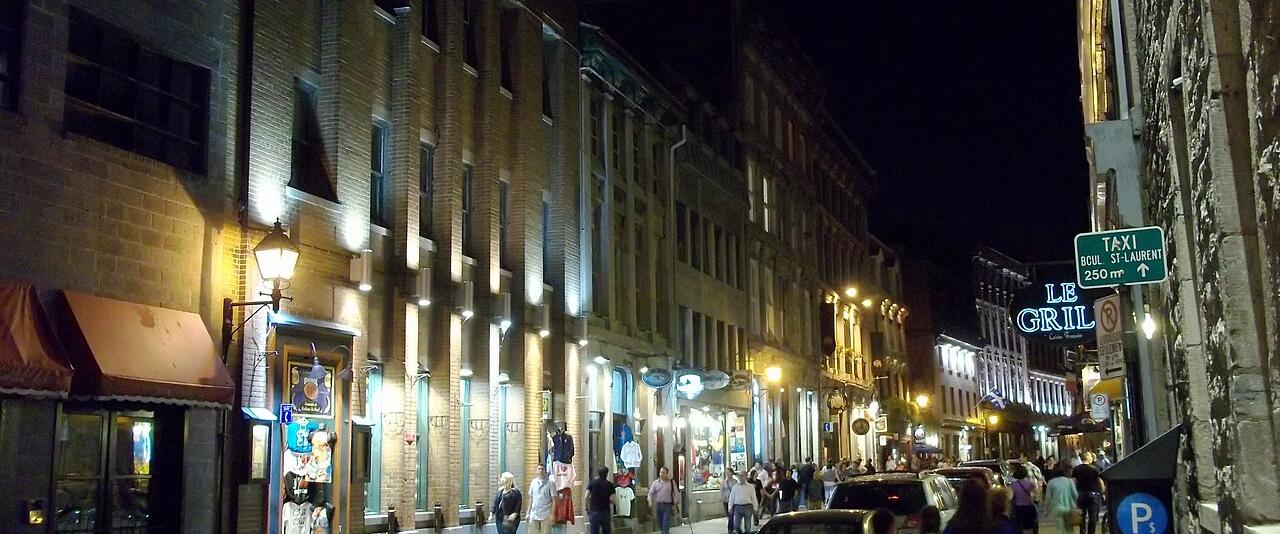
Montreal is the most European city in North America: cobbled lanes in the old port, bagels and smoked meat, festivals all summer and an underground city all winter. It also hanged an enslaved woman for a fire she may not have set, buried thousands of Irish immigrants beside the river, burned down its own parliament, and in the 1950s let a psychiatrist experiment on patients with money from the CIA. In 1989 a gunman murdered 14 women at its engineering school.
Most of these chapters left something behind that you can still find: a black boulder by the Victoria Bridge, a square named after a slave, a row of granite blocks in Côte-des-Neiges. This guide goes through them in order, from 1734 to the present, and tells you where to see each one.
1734: Marie-Josèphe-Angélique
Slavery was legal in New France. Historians have counted about 2,000 enslaved people in the colony under French rule, most of them Indigenous and about 400 of them Black. One was a young woman from Madeira known as Marie-Josèphe-Angélique, owned by a Montreal merchant family on rue Saint-Paul.
On the evening of 10 April 1734 a fire broke out at her owners' house and spread through the town, destroying about 45 houses and the Hôtel-Dieu hospital. Angélique, who had tried to run away weeks earlier, was accused of setting it. She was tortured to force a confession and hanged on 21 June 1734; her body was burned and the ashes scattered. Historians today regard her guilt as unproven.
Where to see it today: Place Marie-Josèphe-Angélique, named in 2012, is a small square facing City Hall, a few steps west of Champ-de-Mars metro. Rue Saint-Paul in Old Montreal, where the fire began, is the city's oldest street.
1838–1839: The Patriotes on the Gallows
In 1837 and 1838 French-Canadian Patriotes rose in armed rebellion against British colonial rule. The second rising was crushed in November 1838, and the British put more than 100 men before courts martial. Ninety-nine were sentenced to death, 58 were transported to Australia, and 12 were hanged at the new Pied-du-Courant prison between December 1838 and February 1839. The best known, the notary Chevalier de Lorimier, wrote a famous farewell letter the night before his execution on 15 February 1839.
 Chevalier de Lorimier, hanged at the Pied-du-Courant prison on 15 February 1839. Image: Jean-Joseph Girouard (1794-1855), Public domain, via Wikimedia Commons.
Hangings continued in Montreal for more than a century. From 1912 they were carried out at Bordeaux Prison, where more than 80 people were executed. The last hanging in Quebec took place there in 1960.
Where to see it today: the Pied-du-Courant prison, 903 avenue De Lorimier, near Papineau metro and the foot of the Jacques-Cartier Bridge. It houses a small exhibition centre, the Prison-des-Patriotes; check opening times before going. The Patriotes monument by Alfred Laliberté stands outside. Bordeaux Prison is still in use and closed to the public.
 The Pied-du-Courant prison, where 12 Patriotes were hanged in 1838–39. Image: Parcours riverain - Ville de Montréal from Canada, CC BY 2.0, via Wikimedia Commons.
1847: Ship Fever
In 1847, the worst year of the Great Famine, tens of thousands of Irish emigrants crossed the Atlantic to Canada in overcrowded ships. Many carried typhus. In Montreal the sick were housed in fever sheds at Windmill Point, by the river, where nuns, priests and local volunteers nursed them and many caught the disease themselves. About 6,000 people died and were buried beside the sheds.
Twelve years later, workers building the Victoria Bridge found the graves. They raised a huge boulder over them in 1859, inscribed: "To preserve from desecration the remains of 6000 immigrants who died of ship fever A.D. 1847-48."
 The Black Rock, raised in 1859 over the graves of about 6,000 Irish immigrants. Image: Coastal Elite from Halifax, Canada, CC BY-SA 2.0, via Wikimedia Commons.
Where to see it today: the Black Rock (Irish Commemorative Stone) stands on a strip of grass near the entrance to the Victoria Bridge in Pointe-Saint-Charles. A memorial park around it is planned by 2030. Every year on the last Sunday in May, the "Walk to the Stone" sets out from St Gabriel's Church.
25 April 1849: The City Burns Its Parliament
From 1844 Montreal was the capital of the Province of Canada, and its parliament met in St Anne's Market on today's Place D'Youville. In April 1849 the Governor General, Lord Elgin, signed a bill compensating people in Lower Canada who had lost property in the rebellions, including former rebels. English-speaking Tories were furious. That evening a mob pelted Elgin with eggs and stones, broke into the parliament and set it on fire. More than 23,000 books in the parliamentary library were lost.
Montreal never served as capital again.
 The burning of the parliament in Montreal, 25 April 1849, attributed to Joseph Légaré. Image: Attributed to Joseph Légaré, Public domain, via Wikimedia Commons.
Where to see it today: Place D'Youville in Old Montreal, between rue McGill and rue Saint-Pierre. Archaeologists from the Pointe-à-Callière museum have recovered more than 350,000 objects from the site since 2010, including charred piles of books; the museum, nearby on Place Royale, tells the story.
1885: Smallpox
In late February 1885 a railway conductor arrived in Montreal sick with smallpox. The disease spread from the Hôtel-Dieu hospital into the city. By the end of the year more than 3,000 Montrealers had died, most of them French-Canadian children, and thousands more were scarred for life.
When the city made vaccination compulsory, many French Canadians, suspicious of the English-speaking health authorities, refused. On 28 September 1885 about 1,000 rioters sacked the Health Department's east-end office and attacked pharmacies, doctors' homes and City Hall.
 Sanitary police removing patients during the 1885 smallpox epidemic, from an engraving after Robert Harris. Image: Robert Harris, Public domain, via Wikimedia Commons.
Where to see it today: there is no memorial.
1918: The Flu and Griffintown
The Spanish flu killed about 3,000 Montrealers in the autumn of 1918. Schools, churches and theatres were closed, and there were so few hearses that streetcars carried the dead. Among the hardest hit were the poor, crowded neighbourhoods by the Lachine Canal, such as Griffintown, the Irish working-class district that grew up from the 1820s and was largely emptied after the 1960s.
Where to see it today: Griffintown, south of downtown, is now a district of new condominiums. A few old brick rows survive among the towers.
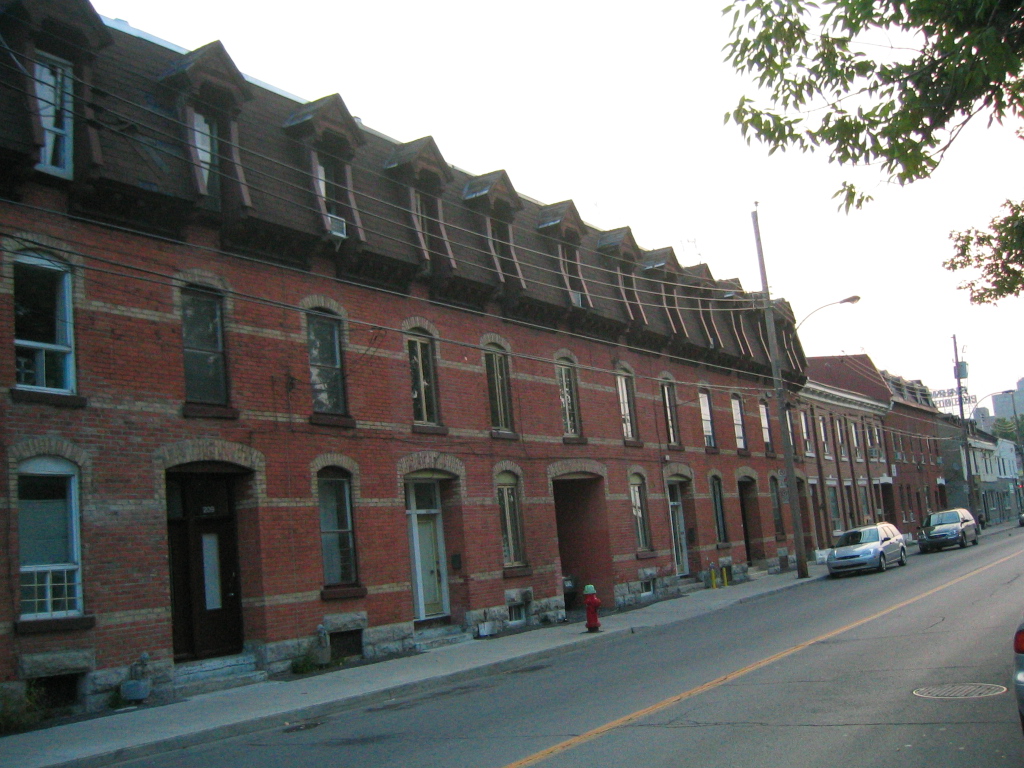 Old rowhouses in Griffintown, the former Irish working-class district. Image: Gilles Douaire, Public domain, via Wikimedia Commons.
9 January 1927: The Laurier Palace Fire
On a Sunday afternoon in January 1927, a fire broke out in the Laurier Palace cinema on rue Sainte-Catherine Est during a children's matinee. In the panic on the stairs, with doors that opened inward, 78 children died, most of them crushed or suffocated. Quebec responded by banning children under 16 from cinemas, a law that stayed in force until 1961, and by requiring doors that open outward.
 The façade of the Laurier Palace cinema after the fire of 9 January 1927. Image: Unknown authorUnknown author, Public domain, via Wikimedia Commons.
Where to see it today: a plaque on the building at 3215 rue Sainte-Catherine Est, now a church. A memorial to the children stands in the Notre-Dame-des-Neiges cemetery on Mount Royal.
The Duplessis Orphans
In the 1940s and 1950s, under Premier Maurice Duplessis, thousands of Quebec children in Church-run orphanages were falsely certified as mentally ill. The reason was money: the federal government paid much more for a psychiatric patient than for an orphan. Some orphanages were simply reclassified as psychiatric hospitals, and children grew up among adult patients. A commission in the early 1960s found that about a third of the 22,000 patients it examined had been wrongly classified.
The Quebec government apologised in 1999 and offered compensation in 2001. The Catholic Church has never accepted responsibility.
Where to see it today: the former Saint-Jean-de-Dieu asylum in east Montreal, later the Louis-H. Lafontaine hospital, is now the Institut universitaire en santé mentale de Montréal. It is a working hospital, not a visitor site.
1957–1964: The Allan Memorial Experiments
In a grand stone mansion on the slopes of Mount Royal, the psychiatrist Ewen Cameron, director of the Allan Memorial Institute, ran experiments he called "depatterning" on his patients. They were given massive electroshocks, put into drug-induced sleep for weeks, dosed with LSD and made to listen to taped messages for hours on end in an effort to wipe out their memories and rebuild their minds. Many had come for treatment for anxiety or depression. From 1957 the work was partly funded by the CIA through its secret MKUltra programme, and the Canadian government added funds of its own.
Cameron died in 1967. In 1992 Canada paid compensation to 127 former patients, and in 2025 a Quebec court authorised a class action on behalf of all the patients and their families.
 Ravenscrag, the mansion that housed the Allan Memorial Institute. Image: The Cosmonaut, CC BY-SA 2.5 ca, via Wikimedia Commons.
Where to see it today: Ravenscrag, 1025 avenue des Pins Ouest, built in the 1860s for the shipping magnate Sir Hugh Allan. Its hospital use ended in 2015. You can see it from the street; the grounds are not open.
1 September 1972: The Blue Bird Café
Late on the evening of 1 September 1972, three men who had been turned away from the Wagon Wheel bar above the Blue Bird Café on rue Union came back and set fire to the only staircase. Thirty-seven people died, most of them trapped upstairs.
Where to see it today: a memorial plaque, unveiled in 2012, is on the south side of Phillips Square, a block from the site.
 The memorial to the 37 victims of the Blue Bird fire. Image: Coastal Elite from Halifax, Canada, CC BY-SA 2.0, via Wikimedia Commons.
6 December 1989: École Polytechnique
On the afternoon of 6 December 1989, a gunman walked into the École Polytechnique, the engineering school of the Université de Montréal. Declaring that he was "fighting feminism", he separated the women from the men in a classroom and shot them. In twenty minutes he killed 14 women and injured 14 more people before killing himself. The victims were Geneviève Bergeron, Hélène Colgan, Nathalie Croteau, Barbara Daigneault, Anne-Marie Edward, Maud Haviernick, Barbara Klucznik-Widajewicz, Maryse Laganière, Maryse Leclair, Anne-Marie Lemay, Sonia Pelletier, Michèle Richard, Annie St-Arneault and Annie Turcotte.
The massacre led to Canada's gun-control laws of the 1990s, and 6 December is now Canada's National Day of Remembrance and Action on Violence Against Women.
 Nef pour quatorze reines, the memorial on Place du 6-Décembre-1989. Image: Eshko Timiou, CC BY-SA 4.0, via Wikimedia Commons.
Where to see it today: Place du 6-Décembre-1989, at avenue Decelles and chemin Queen-Mary in Côte-des-Neiges, near the university. Its memorial, Nef pour quatorze reines by Rose-Marie Goulet (1999), is a row of 14 granite blocks, each with a woman's name.
1994–2002: The Biker War
For eight years Quebec's motorcycle gangs fought over the drug trade with bombs and guns. More than 160 people were killed. On 9 August 1995, a car bomb exploded on rue Adam in Hochelaga-Maisonneuve, and a piece of shrapnel killed Daniel Desrochers, an 11-year-old boy playing nearby. His death turned public opinion and led to a special police squad and, in 1997, Canada's first anti-gang law. His killers were never convicted.
Where to see it today: there is no memorial.
Today's Shadows
- The Big Owe. The Olympic Stadium, built for 1976, cost so much more than planned that Quebec did not finish paying for it until 2006. Its retractable roof never worked properly, and a new one is being built. The leaning tower above it, the tallest inclined tower in the world, has an observation deck reached by funicular.
- Homelessness. Quebec's 2025 count found more than 5,000 visibly homeless people in Montreal, up sharply since 2022. Encampments and shelters are visible around downtown and in the east end.
- Opioids. Montreal records hundreds of overdose deaths a year and runs several supervised-injection sites.
 The Olympic Stadium and its leaning tower at night. Image: Acarpentier (photograph); Roger Taillibert (architect), CC BY 3.0, via Wikimedia Commons.
How to visit: the metro is generally safe, but keep your belongings close at night in the busiest downtown stations.
How to See Dark Montreal Respectfully
A self-guided walk, about 4 km. Start on rue Saint-Paul, where the 1734 fire began, and walk to Place D'Youville and Pointe-à-Callière for the burned parliament. Continue to Place Marie-Josèphe-Angélique by City Hall, then east along rue Notre-Dame to the Pied-du-Courant prison by the Jacques-Cartier Bridge. Take the metro back to Phillips Square for the Blue Bird memorial.
Further afield:
- The Black Rock in Pointe-Saint-Charles, by the Victoria Bridge.
- Ravenscrag on avenue des Pins, seen from the street.
- Place du 6-Décembre-1989 in Côte-des-Neiges.
- The Laurier Palace plaque and the children's memorial in the Notre-Dame-des-Neiges cemetery.
Dates the city remembers:
- 15 February: the hanging of de Lorimier and four other Patriotes.
- Last Sunday in May: the Walk to the Stone.
- 6 December: the École Polytechnique massacre, when, in recent years, 14 beams of light have been shone into the sky from Mount Royal.
A few ground rules. The Black Rock marks a mass grave; don't climb it. At Place du 6-Décembre-1989, families and classmates still come to remember. And at Ravenscrag, remember that some of the patients treated there are still alive.