


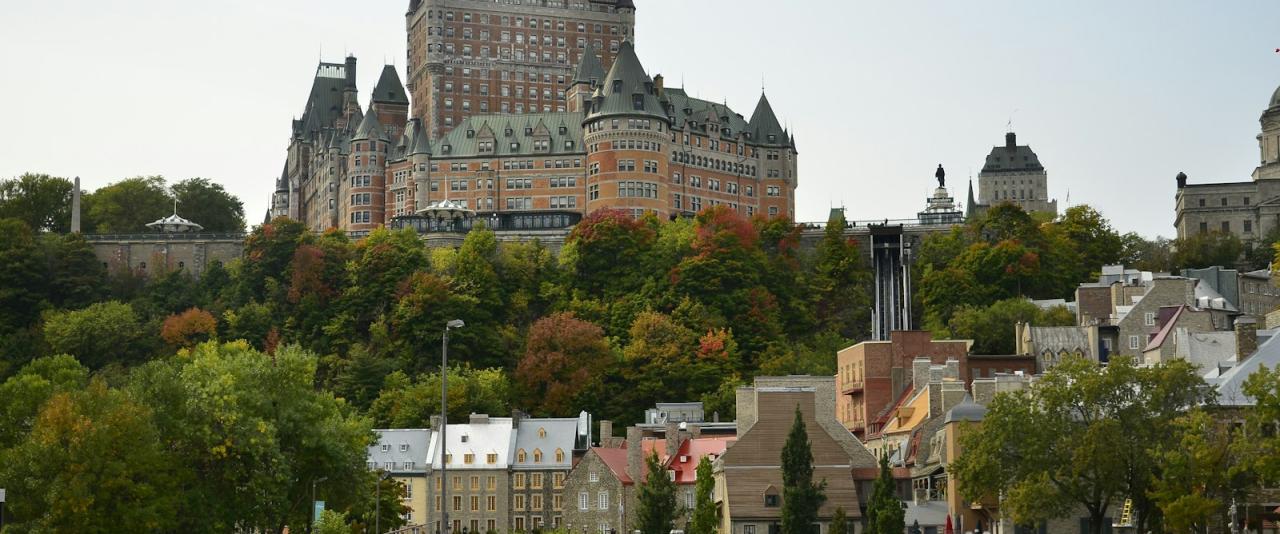
How Old Quebec Is Laid Out
Old Quebec (Vieux-Québec) is the historic core of Quebec City and has been a UNESCO World Heritage Site since 1985. Samuel de Champlain built his first settlement here in 1608, and the district preserves the fortified layout of a colonial capital.
The old city has two levels. The Upper Town (Haute-Ville) sits on top of Cap Diamant, the cliff above the St. Lawrence River, and was the military, religious and administrative centre. The Lower Town (Basse-Ville) lies at the foot of the cliff around Place Royale, where the first settlement and the port grew up. Steep streets, staircases and a funicular connect the two.
The whole district is compact enough to cover on foot in a day, though the hills make it slower than the distances suggest. Comfortable shoes matter more than a detailed plan.
Upper Town: Château Frontenac and Dufferin Terrace
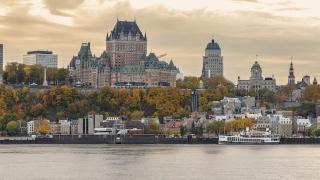
The Château Frontenac, a railway hotel with copper roofs and turrets, is the city's best-known building and the easiest landmark to navigate by. In front of it, Dufferin Terrace is a wide boardwalk along the cliff edge with views across the river to Lévis.
Beneath the terrace, the Saint-Louis Forts and Châteaux National Historic Site shows the excavated remains of the Château Saint-Louis, seat of the French and then British governors for more than 200 years. Parks Canada runs it seasonally; in 2026 the season ran from June 19 to September 7.
From the south end of the terrace, a boardwalk and stairs continue along the cliff toward the Citadelle and the Plains of Abraham.
The Citadelle and the Plains of Abraham
The Citadelle of Quebec is a star-shaped fortress built by the British in the 19th century on the highest point of Cap Diamant. It is still an active military installation, home to the Royal 22e Régiment, and is visited on guided tours.
Next to it, the Plains of Abraham, now part of Battlefields Park, were the site of the 1759 battle between British and French forces that led to the British conquest of New France. Today it is a large urban park used for walking, picnics, concerts and, in winter, cross-country skiing.
Walking the Walls
Quebec City is the only city north of Mexico that has kept most of its fortifications. The walls run for roughly 4.6 km around the Upper Town. You can walk sections of the ramparts and pass through the city gates, including Porte Saint-Louis and Porte Saint-Jean, which lead to the two main streets into the old town. Parks Canada offers guided tours of the fortifications in season.
Rue Saint-Jean, inside the walls, is the main street for shops and restaurants. Rue Saint-Louis runs from its gate down toward the Château Frontenac. Outside Porte Saint-Louis, the Parliament Building of Quebec's National Assembly faces the old town across the boulevard; it is the seat of the provincial government and can be visited.
Lower Town: Petit-Champlain and Place Royale
To reach the Lower Town, take the funicular from Dufferin Terrace or walk down the steep Breakneck Stairs (Escalier Casse-Cou). At the bottom is Rue du Petit-Champlain, a narrow pedestrian street of shops and restaurants at the foot of the cliff.
A few steps away, Place Royale marks the site of Champlain's settlement. Its small stone church, Notre-Dame-des-Victoires, was built between 1687 and 1723. Nearby, the Musée de la civilisation covers Quebec history and society, and the Old Port area extends along the river.
For a view of the whole skyline, take the ferry across the St. Lawrence to Lévis and back. The crossing is short and gives the clearest view of the Château Frontenac above the cliff.
Practical Tips
- Timing: Summer is busiest. The Quebec Winter Carnival in late January and February brings large crowds and cold weather; dress for well below freezing.
- Getting there: VIA Rail trains from Montreal arrive at Gare du Palais, at the edge of the Lower Town and within walking distance of the walls.
- Driving: Parking inside the walls is limited. Park outside the old town and walk in.
- Language: French is the everyday language. English is widely understood in tourist areas, but a few words of French are appreciated.
- Accessibility: The funicular is the easiest way between levels. Many streets are steep, cobbled or icy in winter.